All modern cars have brakes on all four wheels, operated by a hydraulic system. The brakes may be disc type or drum type.
The front brakes play a greater part in stopping the car than the rear ones, because braking throws the car weight forward on to the front wheels.
Disc brakes are generally more efficient, at the front and drum brakes at the rear.
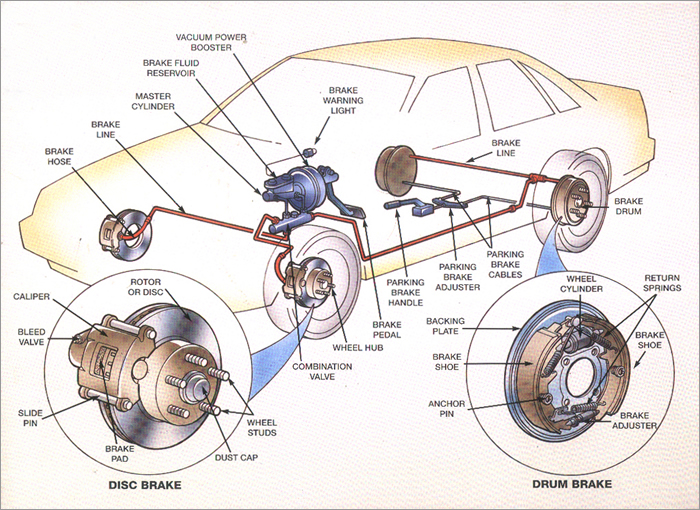
Photo: www.wilsonauto.com
The hydraulic brake is an arrangement of braking mechanism which uses brake fluid, typically containing ethylene glycol, to transfer pressure from the controlling mechanism to the braking mechanism. The brake system converts the kinetic energy of vehicle motion into heat
The most common componenst of the hydraulic brakes for passenger vehicles, motorcycles, scooters, and mopeds,are:
- brake pedal or lever
- a pushrod (also called an actuating rod)
- a master cylinder assembly containing a piston assembly
- reinforced hydraulic lines
- brake caliper assembly usually consisting of one or two hollow aluminum or chrome-plated steel pistons (called caliper pistons), a set of thermally conductive brake pads and a rotor (also called a brake disc) or drum attached to an axle.
See the video to understand how the car brake works
A hydraulic brake circuit has fluid-filled master and slave cylinders connected by pipes. The master cylinder transmits hydraulic pressure to the slave cylinder when the pedal is pressed
As the brake pedal is pressed it depresses a piston in the master cylinder, forcing fluid along the pipe to the slave cylinders at each wheel and fills them, forcing pistons out to apply the brakes.
The new cars usually are fitted with twin hydraulic circuits, with two master cylinders in tandem, in case one should fail.
It is good to know that in case of heavy braking, so much weight may come off the rear wheels that they lock, possibly causing a dangerous skid. Based on this the rear brakes are less powerful than the front.